Exploit Your Web Apps Before Attackers Do
Ares autonomously discovers and exploits vulnerabilities across your web applications — from injection and cross-site scripting to broken access controls and business logic flaws. Every finding is validated through real exploitation, delivering proof of impact instead of theoretical risk scores. Continuously. Autonomously. At machine scale.
WEB APPS
Web App Exposure Validation
Web App Exposure Validation
Accelerates Exposure Validation and Remediation Through Exploitation
PURPOSE BUILT
SELF LEARNING
VALIDATION
01
Map Every Attack Path Across Your Web Applications Body
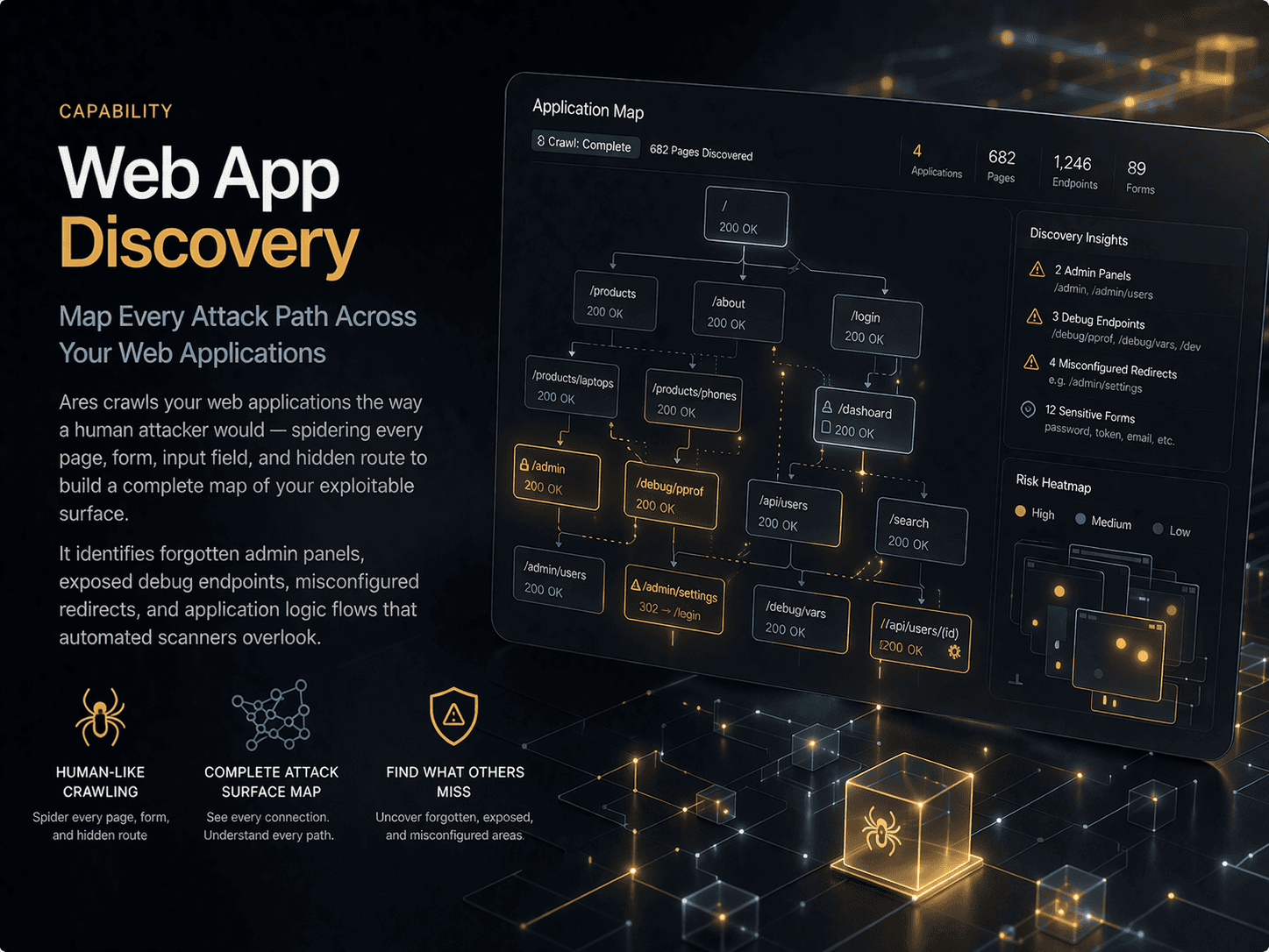
Ares crawls your web applications the way a human attacker would — spidering every page, form, input field, and hidden route to build a complete map of your exploitable surface. It identifies forgotten admin panels, exposed debug endpoints, misconfigured redirects, and application logic flows that automated scanners overlook.
%
of web application attack surface goes untested by traditional scanners due to missed routes, hidden endpoints, and dynamic content
%
of exploitable entry points Ares discovers are found within the first hour of autonomous reconnaissance
PURPOSE BUILT
SELF LEARNING
VALIDATION
01
Map Every Attack Path Across Your Web Applications Body
Ares crawls your web applications the way a human attacker would — spidering every page, form, input field, and hidden route to build a complete map of your exploitable surface. It identifies forgotten admin panels, exposed debug endpoints, misconfigured redirects, and application logic flows that automated scanners overlook.
%
of web application attack surface goes untested by traditional scanners due to missed routes, hidden endpoints, and dynamic content
%
of exploitable entry points Ares discovers are found within the first hour of autonomous reconnaissance
WEB APPS
What Ares Tests Across Your Web Applications
What Ares Tests Across Your Web Applications
Every vulnerability class in the OWASP Top 10 — from injection to broken access control — discovered, exploited, and validated through real attack chains.
Your Entire Application Attack Surface, Unified
Every web and mobile application uncovered during Ares's targeting phase flows into a single operational view — no manual inventory, no context switching. The Applications dashboard aggregates vulnerability findings across your full app portfolio, broken down by severity, remediation status, and finding type. Every vulnerability listed is verified through actual exploitation by Ares, not theoretical detection or passive scanning. Drill into any metric to surface a prioritized table of confirmed findings mapped to industry-standard frameworks, complete with CVSS scores, exploitability classification, affected endpoints, and discovery timestamps — giving security teams and executives an unambiguous picture of real, proven risk.
Precision Filtering Across Every Finding
When you're working across hundreds of confirmed vulnerabilities spanning web and mobile applications, finding what matters fast is critical. Ares's Applications view lets you filter and search the full findings table by keyword — whether you're hunting for a specific host or vulnerability name — and narrow results by severity, exploitability status, and application scan state. Surface only the critical and high findings that are confirmed exploitable, or pull every unscanned application still waiting for assessment. Whatever slice of your attack surface you need, you're one filter away.
Every Finding, Fully Documented
Clicking any vulnerability in Ares surfaces a complete intelligence dossier on that finding and the application it affects. Each detail view includes a full vulnerability summary, a live count of open, verified, remediated, and false positive findings across the application, and a complete targeting history with direct links to past operation reports. Nothing lives in a separate tool or buried in a PDF — every engagement Ares has run against that application, and everything it found, is one click away. Security teams get the full context needed to prioritize remediation, and leadership gets a continuous, auditable record of proven risk over time.
Proof of Exploitation, Not Just a List of Findings
Every Ares operation produces a comprehensive Hybrid Security Assessment Report — a complete, exportable record of everything Ares discovered and proved against your application. The report opens with an overall risk rating and a C-Suite-ready executive summary, then walks through critical findings mapped to OWASP API Top 10 and OWASP Web Application Top 10 (2025) — each one tagged with attacker capability and proof-of-concept evidence. Critical findings like BOLA, SQL injection, XXE, and broken function-level authorization aren't flagged as theoretical risks — they're documented with HTTP responses and PoC evidence confirming real exploitability. The report continues with an interactive 3D endpoint map visualizing safe versus vulnerable nodes across the attack surface, prioritized remediation recommendations with estimated effort and timeline, and a full breakdown of AI token usage across scan operations and report generation. In 26 minutes, Ares ran 176,980 tokens of autonomous offensive reasoning against a target and produced a board-ready deliverable.
FEATURES
Think Like the Attacker. Execute Like One Too.
Think Like the Attacker. Execute Like One Too.
Ares exploits your web applications the way a motivated adversary would — rendering, reasoning, chaining, and proving impact at the speed of your deploy pipeline.
Web Apps
Every category of the OWASP Web Application Top 10 (2021) — exploited, not enumerated. Ares doesn't flag theoretical exposure against a signature database. It proves each vulnerability class through an executed attack, captured evidence, and a reproducible proof-of-concept your engineers can replay on demand.
Web Apps
Every category of the OWASP Web Application Top 10 (2021) — exploited, not enumerated. Ares doesn't flag theoretical exposure against a signature database. It proves each vulnerability class through an executed attack, captured evidence, and a reproducible proof-of-concept your engineers can replay on demand.
Web Apps
Enyo, Ares's web application attack agent, renders and interacts with your application the way a real user does — executing JavaScript, traversing SPA state, triggering dynamic routes, and manipulating client-side logic in React, Angular, Vue, and Svelte. It doesn't match payloads to regex rules. It reasons about the application, identifies where trust is misplaced, and exploits the logic flaw directly.
Web Apps
The vulnerabilities that break companies aren't in the OWASP categories scanners know how to find — they're in how your application actually works. Ares tests for workflow bypasses, price manipulation, race conditions, parameter tampering, privilege escalation through application state, and coupon and rate-limit abuse. It learns the intended flow, then breaks it the way a motivated attacker would.

Web Apps
Ares doesn't stop at a single vulnerability. It chains a reflected XSS into session theft, pivots through a broken access control flaw into an admin panel, then escalates into database exfiltration — and documents every hop with request, response, and captured evidence. You see exactly how a real breach would have unfolded, from initial access to impact.
Web Apps
Ares doesn't stop at a single vulnerability. It chains a reflected XSS into session theft, pivots through a broken access control flaw into an admin panel, then escalates into database exfiltration — and documents every hop with request, response, and captured evidence. You see exactly how a real breach would have unfolded, from initial access to impact.
Your Entire Application Attack Surface, Unified
Every web and mobile application uncovered during Ares's targeting phase flows into a single operational view — no manual inventory, no context switching. The Applications dashboard aggregates vulnerability findings across your full app portfolio, broken down by severity, remediation status, and finding type. Every vulnerability listed is verified through actual exploitation by Ares, not theoretical detection or passive scanning. Drill into any metric to surface a prioritized table of confirmed findings mapped to industry-standard frameworks, complete with CVSS scores, exploitability classification, affected endpoints, and discovery timestamps — giving security teams and executives an unambiguous picture of real, proven risk.
Precision Filtering Across Every Finding
When you're working across hundreds of confirmed vulnerabilities spanning web and mobile applications, finding what matters fast is critical. Ares's Applications view lets you filter and search the full findings table by keyword — whether you're hunting for a specific host or vulnerability name — and narrow results by severity, exploitability status, and application scan state. Surface only the critical and high findings that are confirmed exploitable, or pull every unscanned application still waiting for assessment. Whatever slice of your attack surface you need, you're one filter away.
Every Finding, Fully Documented
Clicking any vulnerability in Ares surfaces a complete intelligence dossier on that finding and the application it affects. Each detail view includes a full vulnerability summary, a live count of open, verified, remediated, and false positive findings across the application, and a complete targeting history with direct links to past operation reports. Nothing lives in a separate tool or buried in a PDF — every engagement Ares has run against that application, and everything it found, is one click away. Security teams get the full context needed to prioritize remediation, and leadership gets a continuous, auditable record of proven risk over time.
Proof of Exploitation, Not Just a List of Findings
Every Ares operation produces a comprehensive Hybrid Security Assessment Report — a complete, exportable record of everything Ares discovered and proved against your application. The report opens with an overall risk rating and a C-Suite-ready executive summary, then walks through critical findings mapped to OWASP API Top 10 and OWASP Web Application Top 10 (2025) — each one tagged with attacker capability and proof-of-concept evidence. Critical findings like BOLA, SQL injection, XXE, and broken function-level authorization aren't flagged as theoretical risks — they're documented with HTTP responses and PoC evidence confirming real exploitability. The report continues with an interactive 3D endpoint map visualizing safe versus vulnerable nodes across the attack surface, prioritized remediation recommendations with estimated effort and timeline, and a full breakdown of AI token usage across scan operations and report generation. In 26 minutes, Ares ran 176,980 tokens of autonomous offensive reasoning against a target and produced a board-ready deliverable.
FAQS
Questions? Answers!
Find Some quick answers to the most common questions.
How is Ares different from a traditional DAST scanner like Burp, ZAP, or Invicti?
Traditional DAST tools pattern-match against known signatures and ship every potential issue as a finding, leaving your team to triage the noise. Ares is an autonomous offensive security platform — our agents (Polemos, Hermes, Kratos, Enyo, and others) plan and execute real attack chains the way a human pentester would, then validate exploitability before anything reaches your report. If Kratos can't actually execute against a finding, it doesn't get surfaced. You get a report of validated, exploitable vulnerabilities — not a backlog of maybes.
How does Ares eliminate false positives?
What does Ares test — and what doesn't it test?
Will Ares disrupt my production environment?
How does Ares handle our authenticated endpoints?
Can Ares detect business logic vulnerabilities?
How long does a typical assessment take, and how often should we run it?
How does Ares integrate with our existing tooling?
What about compliance — can Ares satisfy our pentest requirements for SOC 2, PCI, HIPAA, or FedRAMP?
How is Ares secured, and where does our data live?
What does pricing look like?
Who's behind Ares, and who's already using it?
If you have questions please contact us: sales@assailai.com
FAQS
Questions? Answers!
Find Some quick answers to the most common questions.
How is Ares different from a traditional DAST scanner like Burp, ZAP, or Invicti?
Traditional DAST tools pattern-match against known signatures and ship every potential issue as a finding, leaving your team to triage the noise. Ares is an autonomous offensive security platform — our agents (Polemos, Hermes, Kratos, Enyo, and others) plan and execute real attack chains the way a human pentester would, then validate exploitability before anything reaches your report. If Kratos can't actually execute against a finding, it doesn't get surfaced. You get a report of validated, exploitable vulnerabilities — not a backlog of maybes.
How does Ares eliminate false positives?
What does Ares test — and what doesn't it test?
Will Ares disrupt my production environment?
How does Ares handle our authenticated endpoints?
Can Ares detect business logic vulnerabilities?
How long does a typical assessment take, and how often should we run it?
How does Ares integrate with our existing tooling?
What about compliance — can Ares satisfy our pentest requirements for SOC 2, PCI, HIPAA, or FedRAMP?
How is Ares secured, and where does our data live?
What does pricing look like?
Who's behind Ares, and who's already using it?
If you have questions please contact us: sales@assailai.com
The Ares Web App Kill Chain
From the login page to the database — watch Ares' agentic red team dismantle a web app the way a real adversary would, then prove every finding with reproducible evidence.
Mission Intake & Planning
Every engagement begins with Polemos, Ares' mission commander. She receives the target, scopes the rules of engagement, and decomposes the operation into a multi-phase battle plan — assigning the right specialist agents before a single request hits your app.
Reconnaissance & Surface Mapping
Hermes — Ares' reconnaissance agent — crawls every link, form, and JavaScript bundle in your app. She fingerprints the framework, maps hidden routes, and even extracts the tokens and secrets your client-side code never meant to leak — giving every downstream agent the keys to the kingdom.
CVE & Vulnerability Correlation
Athena turns reconnaissance into intelligence. She correlates every framework version, library, and JavaScript dependency against known CVEs and supply-chain advisories, then hands Enyo a precision target package — so when Ares attacks, she attacks where it actually bleeds.
Web App Exploitation: OWASP Web Top 10 (2025)
Enyo is Ares' web-app enforcer. She drives every OWASP Web Top 10:2025 attack in parallel — XSS, CSRF, SQLi, SSRF, broken access control, supply-chain compromise, cryptographic failures, mishandled exceptions, and dozens of specialist modules from SAML confusion to Citrix Bleed — and returns reproducible proof for every breach.
Autonomous Attack-Chain Reasoning
Real breaches are never one bug — they're a chain. Nemesis stitches Ares' findings into end-to-end attack chains, carrying cookies, tokens, and session state from step to step until she proves how a low-severity leak becomes a full account takeover.
Finding Validation
Every finding faces Aletheia, the goddess of truth and Ares' web-app judge. She independently re-executes each proof against the live target and discards anything she can't reproduce — so your team only ever sees vulnerabilities that are real, exploitable, and ready to fix.
Report Generation & Accuracy Review
Polemos closes the loop — composing the executive summary, business-impact narrative, and step-by-step remediation plan for every finding. Mnemosyne then audits the report against the raw evidence so what reaches your inbox is accurate, defensible, and ready to action.
TEAM
Let's Talk
Let's Talk
Reach out and one of our team members will respond within 1 business day.