Reverse-Engineer and Exploit Your Mobile Apps Before Attackers Do
Ares decompiles, analyzes, and exploits your iOS and Android applications from source code to live runtime — combining static analysis and dynamic exploitation to validate every vulnerability across your mobile attack surface. Hardcoded secrets, insecure data storage, broken certificate pinning, and exploitable API calls — proven through real attacks, not theoretical findings.
MOBLE APPS
Android and iOS App Exposure Validation
Android and iOS App Exposure Validation
Accelerates Exposure Validation and Remediation Through Exploitation
PURPOSE BUILT
SELF LEARNING
VALIDATION
01
Decompile and Map Your Entire Mobile Attack Surface
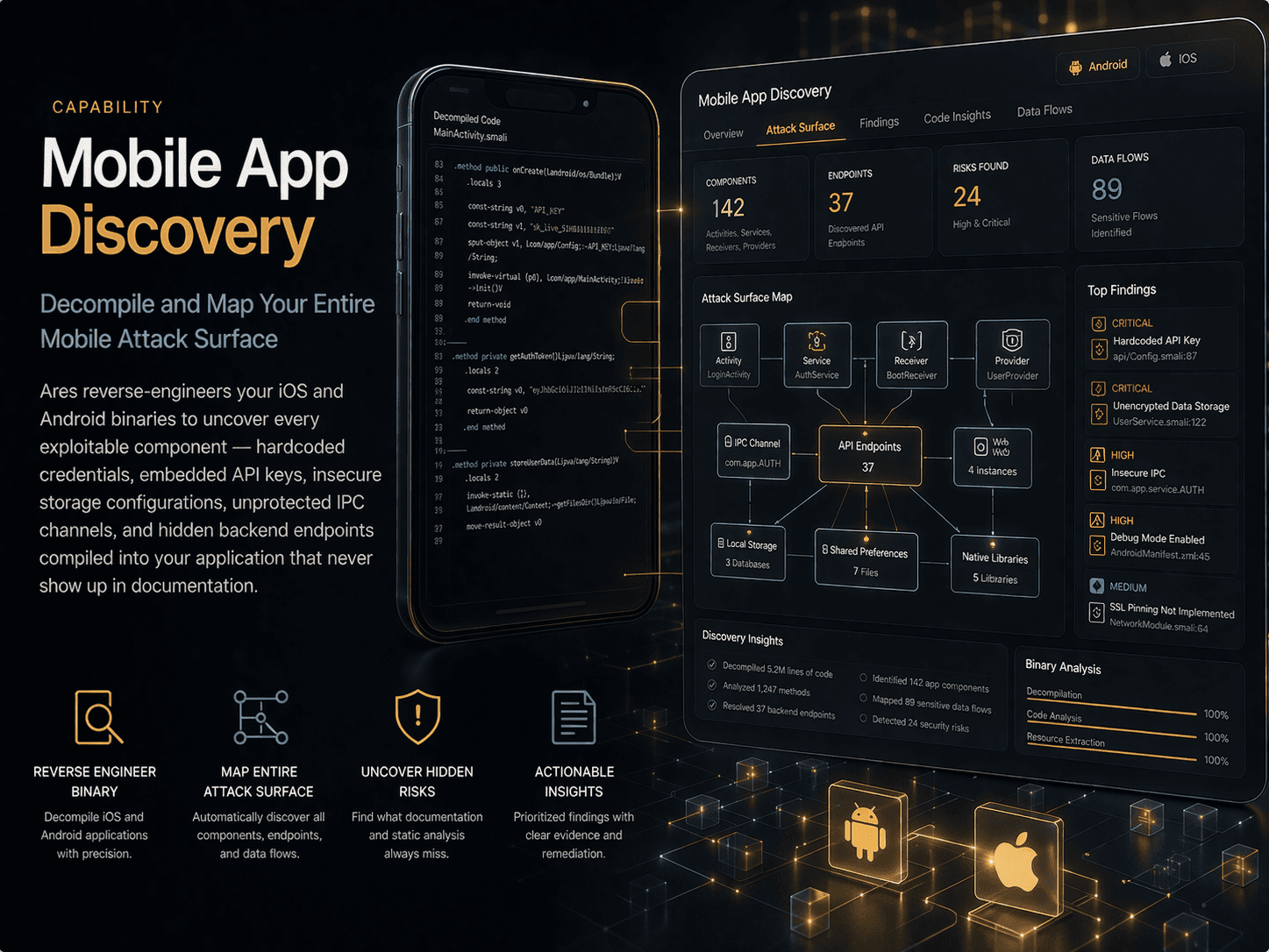
Ares reverse-engineers your iOS and Android binaries to uncover every exploitable component — hardcoded credentials, embedded API keys, insecure storage configurations, unprotected IPC channels, and hidden backend endpoints compiled into your application that never show up in documentation.
%
of mobile apps contain hardcoded secrets compiled into the binary — invisible to App Store and Play Protect review
%
of mobile apps fail to defend against reverse engineering and binary analysis
PURPOSE BUILT
SELF LEARNING
VALIDATION
01
Decompile and Map Your Entire Mobile Attack Surface
Ares reverse-engineers your iOS and Android binaries to uncover every exploitable component — hardcoded credentials, embedded API keys, insecure storage configurations, unprotected IPC channels, and hidden backend endpoints compiled into your application that never show up in documentation.
%
of mobile apps contain hardcoded secrets compiled into the binary — invisible to App Store and Play Protect review
%
of mobile apps fail to defend against reverse engineering and binary analysis
MOBILE APPS
What Ares Tests Across Your Mobile Applications
What Ares Tests Across Your Mobile Applications
From decompiled source code to live runtime — every vulnerability across your iOS and Android apps discovered through static analysis and validated through dynamic exploitation.
Test It the Way an Attacker Would
Most mobile applications are never tested the way attackers approach them. Ares changes that. Upload your APK or IPA, specify your testing scope — SAST, DAST, or both — and choose whether Ares operates unauthenticated or with credentials to simulate a logged-in adversary. Autonomous. Thorough. Unsparing.
Every Secret. Every Weakness. Every Path In.
Ares doesn't just find vulnerabilities — it builds the case. Each mobile report surfaces detected security controls, confirmed vulnerabilities, and live exploit evidence generated during the test. Hardcoded API keys, secrets, and credentials are extracted even when obfuscated, using a model trained on over 340,000 obfuscation pairs. Network endpoints are mapped. And an attack chain analysis lays out the full kill chain — step by step, the way a real adversary would execute it.
Ares Reads Your Code. All of It
Attackers don't need your source code — they reverse engineer it. So does Ares. Every mobile assessment begins with full APK or IPA decompilation back to original source, followed by exhaustive static analysis for vulnerabilities and hardcoded secrets. What comes back isn't a scanner output — it's a hand-authored executive summary, a business impact statement tied directly to your findings, and a ranked action list your team can execute against immediately. This is what a senior security researcher would produce. Ares produces it autonomously.
Not a Finding. A Proof of Exploitation.
Dynamic analysis means nothing without evidence. Ares conducts live penetration testing against your application and delivers findings that can't be argued with — working exploits, server responses captured in real time, and zero false positives. The DAST report surfaces every vulnerability ranked by severity and CVSS score, flags the highest-danger findings demanding immediate attention, and for each one, opens into a complete exploit record: description, business impact, likelihood, step-by-step reproduction, remediation guidance, and the raw server response proving the vulnerability is real and exploitable. This isn't a scan report. It's a closed case file.
Ranked. Mapped. Proven.
Every DAST finding ranked by CVSS severity. CWE classifications. OWASP mapping. Occurrence counts. Live server responses proving successful exploitation. And for every finding — an overview, evidence, impact, likelihood, remediation, and references. Ares shows its work.
Your App's APIs Just Became the Next Target.
Attackers don't stop at the application — they follow it to its backend. Neither does Ares. Every server your mobile app communicates with is surfaced automatically from dynamic analysis. Stage 2 lets you select your targets, set your attack intensity, and choose which OWASP API Security Top 10 categories to test against. One click launches a fully autonomous offensive operation against your API infrastructure — the same infrastructure your application trusts completely. Trust needs to be earned. Ares finds out if it has been.
Every Audience. Every Format. One Report.
Ares findings don't live behind a dashboard. Every assessment is exportable in four formats built for four distinct needs — a full technical PDF report, a C-Suite report distilling risk into executive language, a CSV export for ingestion into your security toolchain, and a JSON report for programmatic integration. The PDF export delivers a professionally formatted, publication-ready document from cover page to final finding — the kind of report your team hands to a client, presents to a board, or submits to a regulator without a second of reformatting.
FEATURES
Past the Binary
Past the Binary
Attackers reverse-engineer every app on their phone. Ares does it first, and proves what they'd find.

Date
Every category of the OWASP Mobile Top 10 (2024) — from insecure authentication and authorization to inadequate cryptography, insecure data storage, insufficient binary protections, and insecure communication — tested through real execution against your live iOS and Android builds. Ares doesn't flag theoretical risk against a signature database. It proves each vulnerability class with extracted data, captured traffic, and a reproducible exploit your engineers can replay against the same binary.
Date
Every category of the OWASP Mobile Top 10 (2024) — from insecure authentication and authorization to inadequate cryptography, insecure data storage, insufficient binary protections, and insecure communication — tested through real execution against your live iOS and Android builds. Ares doesn't flag theoretical risk against a signature database. It proves each vulnerability class with extracted data, captured traffic, and a reproducible exploit your engineers can replay against the same binary.
Date
Static analysis tells you what's in the binary. Dynamic analysis tells you what the binary does in the wild. Ares runs both as a single coordinated operation — decompiling your APK or IPA back to source, identifying hardcoded secrets, unsafe API calls, and misconfigured native libraries, then exercising the application at runtime to confirm which weaknesses are actually exploitable. One upload. One scope definition. A complete picture of your mobile attack surface — what's in the code, and what happens when it runs.
Date
Hardcoded API keys, tokens, certificates, and backend credentials are the single fastest path from a shipped app to a compromised backend — and standard tooling misses them the moment a developer runs an obfuscator. Dagger, Ares's offensive security model, was trained on more than 340,000 obfuscation pairs and pulls secrets out of ProGuard, R8, LLVM-obfuscated, and packed binaries that every other scanner declares clean. If the secret shipped in your app, Ares will find it.

Date
Every mobile application is a navigation chart to the APIs it depends on. Ares captures every endpoint the app talks to during dynamic analysis, then pivots directly into a fully authorized attack operation against that API infrastructure — the same trusted backend the app authenticates to, tested against the OWASP API Security Top 10 at the intensity you define. The result is a single engagement that validates the client, the server, and the trust relationship between them. The way a real adversary would.
Date
Every mobile application is a navigation chart to the APIs it depends on. Ares captures every endpoint the app talks to during dynamic analysis, then pivots directly into a fully authorized attack operation against that API infrastructure — the same trusted backend the app authenticates to, tested against the OWASP API Security Top 10 at the intensity you define. The result is a single engagement that validates the client, the server, and the trust relationship between them. The way a real adversary would.
Test It the Way an Attacker Would
Most mobile applications are never tested the way attackers approach them. Ares changes that. Upload your APK or IPA, specify your testing scope — SAST, DAST, or both — and choose whether Ares operates unauthenticated or with credentials to simulate a logged-in adversary. Autonomous. Thorough. Unsparing.
Every Secret. Every Weakness. Every Path In.
Ares doesn't just find vulnerabilities — it builds the case. Each mobile report surfaces detected security controls, confirmed vulnerabilities, and live exploit evidence generated during the test. Hardcoded API keys, secrets, and credentials are extracted even when obfuscated, using a model trained on over 340,000 obfuscation pairs. Network endpoints are mapped. And an attack chain analysis lays out the full kill chain — step by step, the way a real adversary would execute it.
Ares Reads Your Code. All of It
Attackers don't need your source code — they reverse engineer it. So does Ares. Every mobile assessment begins with full APK or IPA decompilation back to original source, followed by exhaustive static analysis for vulnerabilities and hardcoded secrets. What comes back isn't a scanner output — it's a hand-authored executive summary, a business impact statement tied directly to your findings, and a ranked action list your team can execute against immediately. This is what a senior security researcher would produce. Ares produces it autonomously.
Not a Finding. A Proof of Exploitation.
Dynamic analysis means nothing without evidence. Ares conducts live penetration testing against your application and delivers findings that can't be argued with — working exploits, server responses captured in real time, and zero false positives. The DAST report surfaces every vulnerability ranked by severity and CVSS score, flags the highest-danger findings demanding immediate attention, and for each one, opens into a complete exploit record: description, business impact, likelihood, step-by-step reproduction, remediation guidance, and the raw server response proving the vulnerability is real and exploitable. This isn't a scan report. It's a closed case file.
Ranked. Mapped. Proven.
Every DAST finding ranked by CVSS severity. CWE classifications. OWASP mapping. Occurrence counts. Live server responses proving successful exploitation. And for every finding — an overview, evidence, impact, likelihood, remediation, and references. Ares shows its work.
Your App's APIs Just Became the Next Target.
Attackers don't stop at the application — they follow it to its backend. Neither does Ares. Every server your mobile app communicates with is surfaced automatically from dynamic analysis. Stage 2 lets you select your targets, set your attack intensity, and choose which OWASP API Security Top 10 categories to test against. One click launches a fully autonomous offensive operation against your API infrastructure — the same infrastructure your application trusts completely. Trust needs to be earned. Ares finds out if it has been.
Every Audience. Every Format. One Report.
Ares findings don't live behind a dashboard. Every assessment is exportable in four formats built for four distinct needs — a full technical PDF report, a C-Suite report distilling risk into executive language, a CSV export for ingestion into your security toolchain, and a JSON report for programmatic integration. The PDF export delivers a professionally formatted, publication-ready document from cover page to final finding — the kind of report your team hands to a client, presents to a board, or submits to a regulator without a second of reformatting.
FAQS
Questions? Answers!
Find Some quick answers to the most common questions.
How is Ares different from a traditional DAST scanner like Burp, ZAP, or Invicti?
Traditional DAST tools pattern-match against known signatures and ship every potential issue as a finding, leaving your team to triage the noise. Ares is an autonomous offensive security platform — our agents (Polemos, Hermes, Kratos, Enyo, and others) plan and execute real attack chains the way a human pentester would, then validate exploitability before anything reaches your report. If Kratos can't actually execute against a finding, it doesn't get surfaced. You get a report of validated, exploitable vulnerabilities — not a backlog of maybes.
How does Ares eliminate false positives?
What does Ares test — and what doesn't it test?
Will Ares disrupt my production environment?
How does Ares handle our authenticated endpoints?
Can Ares detect business logic vulnerabilities?
How long does a typical assessment take, and how often should we run it?
How does Ares integrate with our existing tooling?
What about compliance — can Ares satisfy our pentest requirements for SOC 2, PCI, HIPAA, or FedRAMP?
How is Ares secured, and where does our data live?
What does pricing look like?
Who's behind Ares, and who's already using it?
If you have questions please contact us: sales@assailai.com
FAQS
Questions? Answers!
Find Some quick answers to the most common questions.
How is Ares different from a traditional DAST scanner like Burp, ZAP, or Invicti?
Traditional DAST tools pattern-match against known signatures and ship every potential issue as a finding, leaving your team to triage the noise. Ares is an autonomous offensive security platform — our agents (Polemos, Hermes, Kratos, Enyo, and others) plan and execute real attack chains the way a human pentester would, then validate exploitability before anything reaches your report. If Kratos can't actually execute against a finding, it doesn't get surfaced. You get a report of validated, exploitable vulnerabilities — not a backlog of maybes.
How does Ares eliminate false positives?
What does Ares test — and what doesn't it test?
Will Ares disrupt my production environment?
How does Ares handle our authenticated endpoints?
Can Ares detect business logic vulnerabilities?
How long does a typical assessment take, and how often should we run it?
How does Ares integrate with our existing tooling?
What about compliance — can Ares satisfy our pentest requirements for SOC 2, PCI, HIPAA, or FedRAMP?
How is Ares secured, and where does our data live?
What does pricing look like?
Who's behind Ares, and who's already using it?
If you have questions please contact us: sales@assailai.com
A Continuous Security Workflow
A continuous workflow designed to identify risks, monitor threats, and strengthen critical systems before issues escalate.
Mission Intake & Binary Acquisition
Every mobile engagement begins with Polemos. She ingests your APK, AAB, or store listing, validates the scope, and lays out a two-stage attack plan — static reverse-engineering first, live device exploitation second.
Decompilation
Momos — Ares' static-analysis agent — peels your binary apart with JADX, reconstructs the original source, and maps every exported activity, content provider, deep link, and IPC channel the manifest exposes. Nothing your developers compiled in stays hidden.
Protection & Obfuscation Analysis
Before attacking, Ares measures the armor. Momos identifies every packer, obfuscator, and anti-tamper defense your app ships — then strips them back so the real code can be read, scanned, and ultimately broken.
Secret & Credential Hunting
Momos hunts every hardcoded secret your binary ships — API keys, cloud credentials, JWT signing keys, embedded backend URLs — and an AI layer validates each one to ensure what you see is what an attacker could actually exploit.
Vulnerability Pattern Analysis
Momos doesn't just list bad patterns — she connects them. Insecure storage finds its plaintext secret. A missing pinning check finds the API it leaks. Every static finding comes with the live target it threatens.
SAST Review Gate
Before Ares attacks the live backend, she stops and asks. Polemos surfaces every static finding and discovered endpoint for your review — so you control exactly what gets touched in production.
DAST Preflight: Credentials & Feasibility
Dolos prepares the assault. She bundles your app for real-device execution, validates that dynamic testing is feasible, and stages credentials — so when the device boots, Ares is ready to behave like a real user from the first second.
Live Device Execution & UI Exploration
Dolos drives your app on a real phone. An AI operator logs in, taps through every screen, fires deep links, and exercises the high-risk flows Momos flagged — generating the live traffic an attacker would, but in a controlled lab.
Traffic Interception
While the app runs, every encrypted call it makes is captured. Ares' man-in-the-middle layer records the real URLs, tokens, and payloads your mobile app sends to your backend — the traffic your APM never sees.
Traffic Analysis & SAST↔DAST Correlation
Static findings become real here. Dolos correlates every intercepted request against Momos' discoveries — proving that the secret in the binary is the same one in the request header, and that the insecure flag is the same one bleeding data over the wire.
Backend API Red Team
Every API your mobile app talks to inherits the full API kill chain. Hermes, Athena, Kratos, Pallas, and Nemesis attack the backend exactly the way the mobile app uses it — surfacing the server-side weaknesses that only a real client could reveal.
Mobile Finding Validation
Every API your mobile app talks to inherits the full API kill chain. Hermes, Athena, Kratos, Pallas, and Nemesis attack the backend exactly the way the mobile app uses it — surfacing the server-side weaknesses that only a real client could reveal.
Report Generation & Accuracy Review
Polemos closes the loop — composing the executive summary, business-impact narrative, and step-by-step remediation plan for every finding. Mnemosyne then audits the report against the raw evidence so what reaches your inbox is accurate, defensible, and ready to action.
Clue
Details regarding this evidence...
TEAM
Let's Talk
Let's Talk
Reach out and one of our team members will respond within 1 business day.