Federal & State Goverment
Autonomous offensive security at the scale of the citizen-facing mission.
Industry Solutions
Business reasons and regulatory frameworks driving AEV investments in Federal and state government agencies
OUR WHY
Ares for Federal & State Government
Digital services are now critical infrastructure. The threat model caught up before the workforce did.
Every level of government delivers its mission through software now. The IRS files a hundred million returns through APIs. The VA serves veterans through portals and mobile apps that touch the most sensitive PII in the federal inventory. CMS moves trillions of dollars in healthcare claims through programmatic interfaces. State unemployment systems, motor vehicle agencies, public benefits platforms, election infrastructure, and tax modernization programs all run on the same API-mediated architecture the private sector runs on — without the budget, the headcount, or the talent pipeline the private sector takes for granted. Adversaries have noticed. Pandemic-era fraud against state unemployment systems exceeded a hundred billion dollars and exploited API and business-logic flaws no annual assessment surfaced. Nation-state actors have pre-positioned inside U.S. critical infrastructure that includes federal civilian and state systems. Ransomware crews shut down municipalities and counties on a weekly cadence. Meanwhile FedRAMP, StateRAMP, CISA Binding Operational Directives, OMB M-22-09 zero-trust mandates, the federal Secure Software Development Framework, and the IG community all now expect demonstrable, continuous evidence of adversarial testing — not a once-a-year report. Ares closes that gap — autonomously, continuously, and at the scale every citizen-facing mission actually requires.
The Threat Surface
The attack surface that grew with every digital service initiative and never got the staff to defend it.
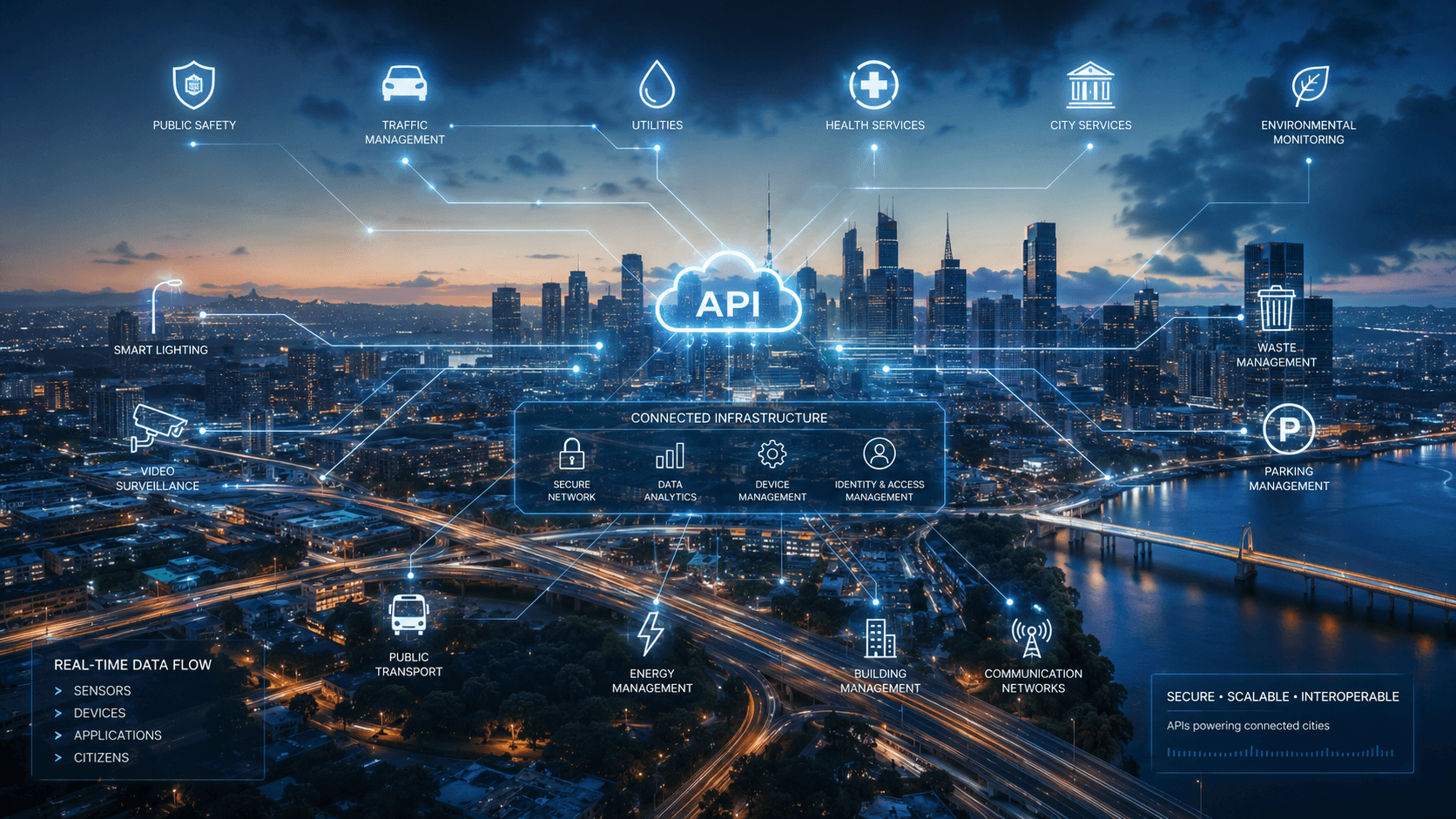
The modern government enterprise is a federation of APIs spanning citizen services, payments, identity, health, and public safety, each with its own trust boundary and its own integration sprawl. Citizen-facing portals — benefits, taxes, licensing, permitting, unemployment, healthcare exchanges — expose APIs that move the most sensitive personal information any citizen surrenders. Identity systems like Login.gov, ID.me, and state-level equivalents sit at the center of the trust model and are probed continuously by credential-stuffing operators and synthetic-identity fraud crews. Payment and disbursement APIs move benefits, refunds, grants, and contract payments at a velocity fraud automation is built to exploit. Health platforms — CMS, state Medicaid systems, public health surveillance, immunization registries — expose APIs whose compromise hits both PHI and program integrity. Public safety and justice systems carry data whose exposure has irreversible consequences for individuals. Court e-filing platforms, motor vehicle systems, and election adjacent infrastructure each carry their own consequence profile. Mobile applications put the same surface in every citizen's pocket on iOS and Android. Cloud modernization across AWS GovCloud, Azure Government, and Google Public Sector distributes that surface across configurations no single team owns end-to-end. And the contractor and integrator ecosystem — the primes and subs who build and operate most of this — extends every agency's attack surface across a supply chain that auditors, not adversaries, were the original audience for. No annual third-party assessment can keep pace with that. Ares can.
The Ares Platform
Autonomous offensive security, purpose-built for the public mission.
Ares deploys a coordinated swarm of AI agents against your APIs, web applications, and mobile apps. Each agent is purpose-built — for reconnaissance, exploit synthesis, kill-chain execution, and validation — and they work together the way a real adversary would. Our API agents enumerate and test the endpoints behind benefits, tax, health, identity, payment, and licensing systems, including the shadow APIs that integration sprawl and contractor handoffs generate faster than any inventory can track, with full coverage of the OWASP API Security Top 10 and the chained business-logic attacks that scanners cannot see: broken authorization on citizen records, replay against disbursement endpoints, privilege escalation through federated identity, eligibility-rule manipulation, and the synthetic-identity flows that turned pandemic-era benefits programs into the largest fraud event in U.S. history. Our web agents probe authentication, session handling, and authorization across citizen portals, agency staff applications, and partner extranets. Our mobile agents test iOS and Android applications end-to-end — the apps citizens use to file, claim, renew, and report. Ares is designed for the operational realities of public-sector deployment: severity-tiered findings, operator attribution, and full evidentiary chains suitable for FedRAMP and StateRAMP authorization packages, IG response, OIG audits, and CISA reporting; deployment paths aligned to FedRAMP Moderate and High environments and to state authorization equivalents; and continuous, mission-safe operation against production, staging, and every release candidate before it reaches a citizen.
The Outcomes
Outcomes that matter to public-sector security leaders and the missions they answer to.
Ares is built to move the metrics that show up in IG reports, OMB scorecards, GAO findings, and the briefings to your governor, your agency head, or your committee of jurisdiction — not the ones that decorate a dashboard. It protects citizen trust by closing the API and business-logic flaws that turn a routine Tuesday into a notification letter sent to several million constituents. It defends benefits and disbursement programs against the synthetic-identity and authorization-flaw exploitation that turned pandemic-era programs into a generational fraud event. It hardens citizen-facing identity infrastructure against the credential-stuffing and account-takeover automation operating against the public sector around the clock. It de-risks the integrator and contractor ecosystem by extending continuous offensive testing across the supply chain that builds and operates most of the public mission. It produces audit-grade evidence of continuous adversarial testing for FedRAMP, StateRAMP, CISA Binding Operational Directives, OMB zero-trust mandates, the federal Secure Software Development Framework, NIST 800-53, and state-level equivalents — replacing point-in-time assessments with a defensible, always-on record. And it does it at the scale public-sector budgets and headcount were never going to reach on their own. Ares was built by an operator whose offensive security career began inside the U.S. Intelligence Community and at the Pentagon. Her research has been cited in U.S. Congressional proceedings, contributed to the OWASP API Security Top 10 that federal and state acquisition language now references, and informs Assail's active pursuit of FedRAMP authorization. When Ares tests your environment, it tests it the way the most patient, most resourced adversary would. The difference is that this time, the report comes to you — before it comes to your IG, your governor, or the press.
TEAM
Let's Talk
Reach out and one of our team members will respond within 1 business day.