Alissa Knight
The Next Competitive Frontier Isn't Model Size. It's What You Wrap Around It.
For three years, the public discourse on artificial intelligence has been obsessed with a single variable: the model. Parameter counts. Benchmark scores. The race between Anthropic, OpenAI, Google, and DeepSeek for the next decimal point of MMLU (Massive Multitask Language Understanding); MMLUs are a benchmark for evaluating LLMs through multiple choice questions. Every release cycle reignites the same tribal debate over which frontier model is "smartest," as though intelligence itself were a leaderboard ranking.
On May 12, Microsoft quietly upended that framing, overtaking Anthropic's Mythos at the top of the CyberGym leaderboard. Yet the industry conversation hasn't moved. Everyone is still benchmarking their products against Mythos, a system none of the companies using it for marketing fodder have ever actually touched.
A team called Autonomous Code Security, led by Taesoo Kim, the Georgia Tech professor whose Team Atlanta won the DARPA AI Cyber Challenge in 2025 with a $29.5 million purse announced MDASH. It surfaced sixteen previously unknown vulnerabilities in Windows, four of them Critical remote code execution flaws that shipped in this month's Patch Tuesday. It scored 88.45%, beating Anthropic's purpose-built cybersecurity model Mythos by five percentage points and outperforming OpenAI's GPT 5.5 by seven.
Here is the part worth sitting with: Microsoft did this without using either of those specialized models. They built nothing proprietary at the model layer. They pre-existing models, the same ones anyone reading this can access What they built was the harness.
And the harness, it turns out, is what won.
What's a Harness?
In the agentic AI lexicon, a harness is the orchestration layer that sits between the model and the world. It is, quite literally, what you wrap around the model. The pipeline. The plumbing. The choreography. The model is a reasoning engine. The harness is what gives that engine purpose, constraint, and direction.
Consider the difference between issuing a single prompt to a language model and running an agentic system. The first is a transaction. The second is a workflow. A harness is what turns one into the other: it sequences calls, routes inputs to specialized sub-agents, validates outputs against criteria the model itself cannot enforce, manages memory across turns, invokes external tools, and constructs the loops in which the model can plan, act, observe, and revise.
The most useful metaphor I can offer is automotive. The model is the engine of a Formula One car. It is extraordinary in isolation, but incapable of winning a race by itself. It requires a chassis, a transmission, suspension, brakes, telemetry, a pit crew, and a strategist who knows when to call for fresh tires. The harness is everything in that sentence that is not the engine. And in the same way that no Formula One team would describe its competitive advantage as "we have the best engine block," no serious AI system today competes on model alone.
What MDASH proves
The architecture Microsoft described deserves close reading, because it crystallizes what a sophisticated harness actually does.
MDASH orchestrates more than one hundred specialized agents through a five-stage pipeline: prepare, scan, validate, dedup, prove. The prepare stage builds language-aware indices of the target codebase and reasons over historical commits to model the attack surface. The scan stage dispatches auditor agents across candidate vulnerability paths. The validate stage is where the architecture becomes elegant. A second cohort of debater agents argues for and against each finding's exploitability, while a separate frontier model is brought in as an independent counterpoint. Disagreement between agents is treated as signal, not noise. The dedup stage collapses semantically equivalent findings. The prove stage constructs an actual triggering input that demonstrates the bug is real, not theoretical.
No single language model, no matter how capable, can do this in one pass. The vulnerabilities MDASH found in Windows were chosen by Microsoft's authors as illustrative precisely because they require cross-file pattern comparison, multi-step reachability analysis, and proof construction, none of which is visible to a model handed a single function and asked "is this safe?" The intelligence is distributed across the system. The model is one input among many.
That last sentence is not mine. It is a direct quote from Microsoft's announcement, and I would suggest it is the most consequential line in AI security writing this week:
"The model is one input. The system is the product."
Why the model-centric emphasis is misguided
Three reasons, in ascending order of importance.
First, the model lottery. Every six months, a new frontier model arrives. If your system's value proposition is gated on a particular model, on its prompt format, its quirks, its idiosyncratic strengths, you are in the business of rebuilding your product every two quarters. Any architecture worth its salt assumes the model will change and is engineered to absorb that change as a configuration flip rather than a rewrite. MDASH was explicitly designed this way. Microsoft has been refreshingly candid that the harness's targeting, validation, dedup, and proof stages are model-agnostic by construction. A product whose entire value is its model is a product that must be rebuilt with every release cycle of the underlying lab.
Second, the capability ceiling. A single model has a single distribution of strengths and weaknesses. An ensemble, particularly one in which models actively debate each other and surface disagreements as evidence, exceeds the capability of any of its individual members. This is not novel statistical thinking; it is bagging and boosting from the 1990s applied to a new substrate. But the practical implication is profound. The next frontier of capability does not come from a bigger model. It comes from better composition. MDASH at 88.45% beat purpose-built single-model cybersecurity systems precisely because no single model, however specialized, can match the epistemic discipline of a hundred agents arguing each other into clarity.
Third, defensibility. This is the part that should hold the attention of every founder, investor, and CISO reading this. Anyone with a credit card can call the OpenAI API. The model itself is the most commoditized layer in the entire AI stack. What is not commoditized is the engineering required to compose a hundred specialized agents into a system that finds zero-days in the Windows kernel. The harness is where the differentiation lives. It is where domain expertise gets encoded. It is where the moat actually is.
I will offer a concrete example from our own work. At Assail, we built Ares, an autonomous offensive cyber platform that coordinates up to one hundred specialized agents per operation through a hierarchical reasoning model in it's current version we call Dagger with specialists like Hermes for discovery and Pius for exploit chaining. Ares trains herself continuously through what we call the Javelin co-evolutionary loop: a Game Master agent generates synthetic war games, a Breacher agent solves them, and the two are balanced through an F1 score so the challenges never become too easy or too hard. This produces new offensive tradecraft nightly, without consuming human-tagged data and without any dependency on what any frontier lab has decided to ship that quarter. The defensibility is not the model. The defensibility is the loop. And the loop lives in the harness.
We made another decision worth naming here. Ares does not use MCP for inter-agent communication. We use a proprietary gRPC protocol instead, deliberately, because we believed early on that the harness itself is part of the attack surface we are responsible for hardening, and we did not want to ship offensive tooling stitched together with a generalist protocol whose vulnerability properties we did not fully control. That kind of decision lives entirely in the harness. The model never sees it. The customer never asks about it. And yet it is one of the reasons our platform is deployable into the environments our customers actually operate in, including disconnected enclaves where no MCP wrapper would ever pass review.
To put it bluntly: if your AI company's pitch deck rests on which model you have access to, you do not have a defensible business. You have a wrapper. And wrappers do not survive the next API price war.
The harness as the soul of agentic AI
If you want to understand why "agent" has become the most-used and least-understood word in AI in 2026, the answer is hiding in plain sight: an agent is a harness. The agent is not the model. The agent is the loop the model runs inside.
When someone tells you they have built an AI agent, what they have actually built is a harness that gives a model the ability to act. To call tools. To read external state. To plan a sequence of actions. To reflect on the results. To recover from errors. To compose its own work into something coherent. The model is the cognitive engine. The agent is the embodiment. Without the harness there is no agent. There is just a chatbot with delusions of agency.
This holds at every layer of the stack. A research agent is a harness that orchestrates search, retrieval, synthesis, and citation. A coding agent is a harness that orchestrates code reading, code writing, test execution, and revision. A vulnerability discovery agent, to take the example in front of us, is a harness that orchestrates static analysis, dynamic execution, structured debate, and exploit proof. The work, the engineering, the differentiation, the value: all of it lives in the harness. The model is increasingly the easy part.
What this looks like from our side
I will close with the disclosure I have been building toward throughout this piece. I am the CEO of Assail, where we have been building harnesses since before the word entered the broader AI vocabulary. We built Ares because the application-layer attack surface our customers operate, in some cases more than a million APIs against a single mission environment, cannot be meaningfully covered by humans alone. Because no off-the-shelf model, however capable, knows how to chain a business-logic flaw into a privilege escalation into a data exfiltration the way a coordinated swarm of specialized agents does. We built our own hierarchical reasoning model because the offensive use case demanded it. But the model has always been half the picture. The other half, the half that grows month over month and ships with every release, is the harness.
That harness is also where most of our hardest engineering has gone. The Palemos middle-management layer that decomposes mission plans into agent-level tasks. The Javelin co-evolutionary loop that produces new tradecraft nightly without human-tagged data. The safe-mode behavior that replaces state-changing actions with OPTIONS-style probes so we can validate exploitability without altering the target. The tenant isolation, the bring-your-own-key encryption, the target-list enforcement at the admin layer, the deliberate refusal of MCP, the low-and-slow TLS 1.3 tradecraft on the wire. None of that is the model. All of it is the harness.
In June we are shipping Sidewinder, the next generation of that harness. It is the largest architectural evolution Ares has undergone since launch, and it represents what we believe a production offensive harness needs to look like for the next phase of this work: more agents, deeper specialization, tighter orchestration, and a tradecraft loop that compounds faster than the threat landscape can adapt. I will have more to say about Sidewinder closer to release.
The takeaway here is not that Assail and Microsoft are doing the same thing. We are doing very different things. Different missions, different threat models, different deployment surfaces. The takeaway is that the architectural pattern is converging across teams that have actually built this kind of system at scale, in adversarial conditions, against attack surfaces that do not forgive sloppiness. The pattern is the harness.
The right question
We are entering a phase in which the durable companies in AI will not be the ones with the largest models. They will be the ones with the most thoughtful systems wrapped around models, or, in our case, around proprietary models we built ourselves because the mission required it. Either way, the strategic frontier has moved up a level, into the harness, into composition, into the architecture of agentic systems.
If you are evaluating AI products, stop asking which model the product uses. Ask what the system does with the model, and what survives when the next model arrives. That is the right question now. Microsoft just told you so in a blog post, and demonstrated it with sixteen new Windows CVEs the world did not know existed. We have been telling our customers the same thing, and demonstrating it on their attack surfaces.
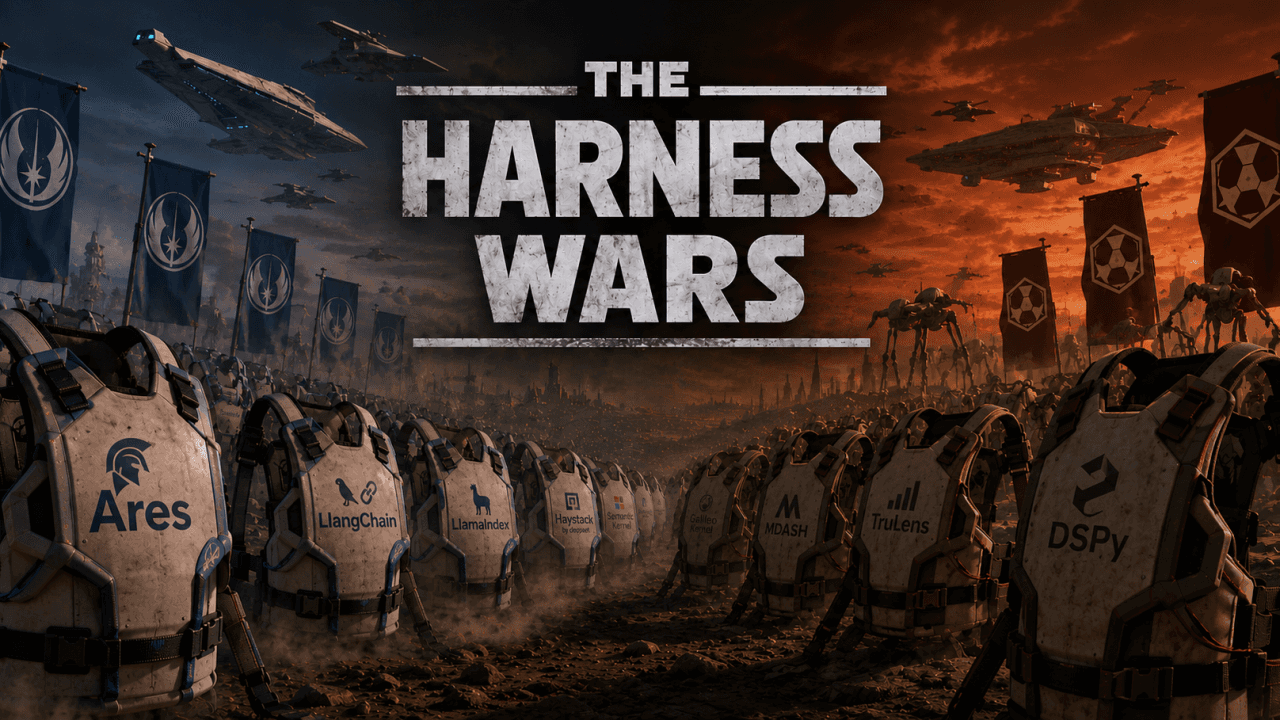
The harness wars have begun. The model is one input. The system is the product.
And the companies that understand this distinction will be the ones still standing when the next frontier model ships, and the one after that, and the one after that.
About the Author
Alissa Knight is the CEO and founder of Assail, Inc., the Boston-based offensive cybersecurity company behind Ares, the world's first autonomous red teaming platform for APIs, web applications, and mobile apps. Her career began inside U.S. intelligence cyber operations and matured into the enterprise where she spent decades breaking the APIs of connected cars, financial platforms, and healthcare systems. That research was cited on Capitol Hill and helped shape federal cybersecurity policy of healthcare APIs. A published author and recognized voice on AI-driven offensive security, she writes and speaks regularly on the architecture of agentic AI, offensive tradecraft, and the strategic shift from model-centric to harness-centric thinking. Sidewinder, the next generation of the harness underpinning Ares, ships in June 2026. For more information on Assail and Ares, visit https://www.assailai.com